Everything We Learned Visiting The Set Of Marvel’s ‘VisionQuest’: The Mind Space, New Family And Wardrobe Secrets
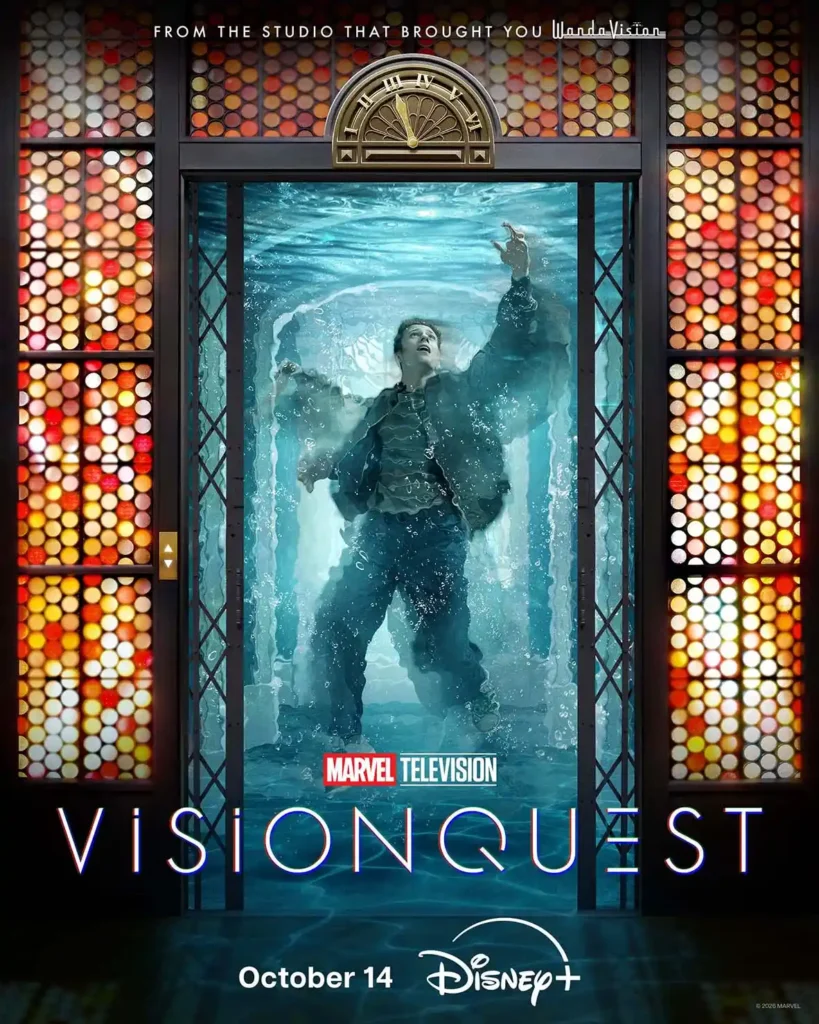
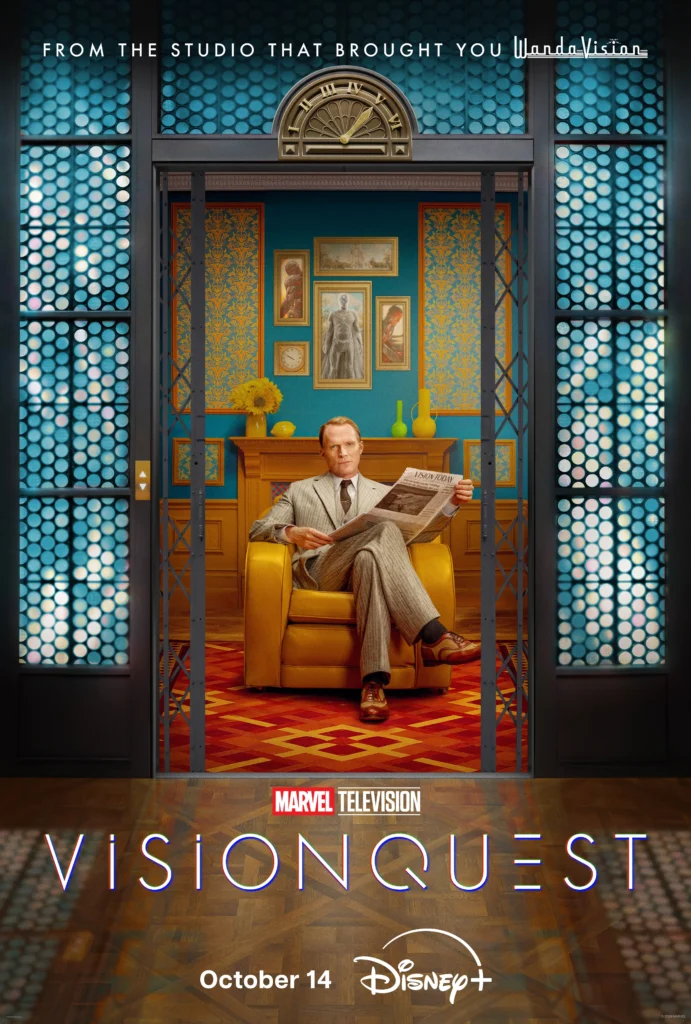
Last summer, Blavity visited the set of Marvel Television’s VisionQuest at Pinewood Studios, where cast and crew spoke with reporters about the upcoming series. This summer, Marvel confirmed at D23 that the show premieres exclusively on Disney+ on Oct. 2026, closing out the trilogy that began with 2021’s WandaVision and continued with 2024’s Agatha All Along.
Per the official synopsis, Vision has been rebooted and is hiding out after escaping the people who wanted to weaponize him. Searching for new meaning, he consults the AI personas embedded in his own programming, including F.R.I.D.A.Y., E.D.I.T.H., J.A.R.V.I.S., and Ultron. His discreet existence ends when a bounty on his head puts him on the run with Thomas Shepard, a mysterious boy who may be Vision’s son, reincarnated. Vision has to evade capture, confront his own nature, resist Ultron’s influence, and figure out who his young companion really is.
The series stars Paul Bettany, James Spader, Ruaridh Mollica, Todd Stashwick, T’Nia Miller, Lauren Morais, Orla Brady, Diane Morgan, Polly Frame, Henry Lewis, Jonathan Sayer, with Emily Hampshire and James D’Arcy. It’s directed by Christopher J. Byrne, Gandja Monteiro, Vincenzo Natali, and Terry Matalas, and written by Matalas, Cindy Appel, Christopher Monfette, Nicole Falsetti, and Matthew Okumura. Matalas created the series for television, based on the Marvel Comics. Kevin Feige, Louis D’Esposito, Brad Winderbaum, Mary Livanos, Matalas, Jac Schaeffer, and Byrne executive produce, with Roopesh Parekh producing.
The story, according to the creative team
On set, Matalas and Byrne described the series as two parallel storylines: one in the real world, one inside “the mind space,” a house that exists only in Vision’s head. They described it as a theatrical stand-in for how a quantum computer processes information, built around themes of grief, identity, and a father-son relationship that spans three generations.
Vision in this series is the White Vision who split off at the end of WandaVision. Matalas and Byrne said he isn’t a copy of the Vision from Age of Ultron and the earlier films; he’s the original body, with his memories unlocked but without the emotional connection to them he once had. They compared it to waking up after years in a coma: the facts are there, but the feelings aren’t.
The mind space is where Vision goes to process what he encounters in the human world, populated by AI companions who appear there in human form. Matalas and Byrne said Vision himself insisted on the human avatars, as part of his own effort to understand humanity.
James Spader returns as Ultron, this time acting opposite Bettany in person rather than through motion capture. Ultron’s role ties back to the Stark legacy that runs through the season, alongside a new antagonist: Paladin, a bounty hunter from the comics who hasn’t previously appeared in the MCU, described on set as a morally gray character.
The team also confirmed that Vision already knows Wanda Maximoff is dead at the start of the story.
Hair, makeup, and prosthetics
The mind space set includes small, deliberate imperfections, such as a banister that doesn’t fully connect to the stairs. The team described this as a nod to how AI-generated images can look almost right but slightly off, even though no AI tools were used in designing the show itself.
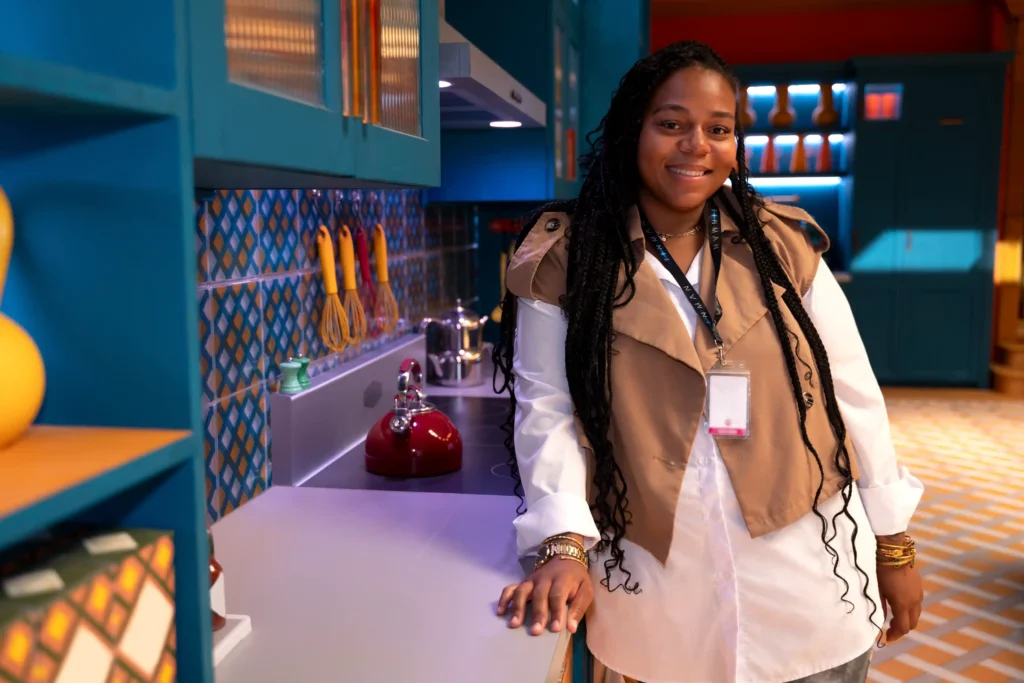
Hair, makeup, and prosthetics designer Frances “Fran” Hounsom described the nature of the job this way: “If it’s a good week, you won’t notice it, which is great.” She said she’s produced roughly 200 concept sketches for the series so far. Because U.K. productions typically combine hair, makeup, and prosthetics under one department, Hounsom said she’s been able to keep Vision’s look consistent as the character changes across the season.
That work included developing a new custom paint mixture for Bettany’s White Vision, recreating a scar tied to an earlier MCU film’s storyline, and building a functioning mechanical device under a prosthetic arm that lights up on camera, using a custom silicone to let light shine through. For Spader’s Ultron, Hounsom grew out and colored his beard, fading it from color at the top to silver and white to echo Ultron’s design. She said she avoided referencing Agatha or WandaVision’s looks for the characters Tommy and Billy, and instead pulled inspiration from the original 1960s Vision comics.
Costume design
Costume designer Sarah Young said she started from the idea of how AI would represent clothing: looks that read as normal at first glance but are subtly off on closer inspection. Vision’s suit fabric is cut on the bias instead of straight grain, and what looks like a pinstripe pattern is actually lines of code, written by Matalas and the writers’ room, printed to fade in and out across the fabric. Vision’s tie and a hand-knit jumper both incorporate his classic android silhouette lines, and his shirt is subtly paneled to represent the Mind Stone.
Because only two surviving White Vision suits made it over from WandaVision, and those had degraded in storage, Young’s team rebuilt the look from scratch through a new costume-effects department she set up for the production.
E.D.I.T.H. has the largest wardrobe of any character in the show. Young built a red, blue, and yellow color palette to keep Emily Hampshire’s many E.D.I.T.H. personas, including a boxer, a matador, a priest, a racer, and a field medic, visually cohesive against the otherwise monochrome mind space.
Ultron’s costume was developed closely with Spader, with a not-quite-period silhouette meant to reflect the character’s research into art and culture within the mind space. Young worked Ultron’s robotic silhouette lines into the coat’s seams, buttons, and belt buckle, in a silver and gunmetal palette with a hint of red. Paladin’s look was built to blend into a crowd, with a hood, glasses, and both a tactical and a “cheap” street version of his jacket, along with a Latin-inscribed crest Young designed for the character.
Tommy’s jacket does double duty in his cover as a grifter. “He has to be able to be one person down this end of the street, and by the time he gets to the other end of the street, he’s turned himself into somebody else,” Young said. The jacket reverses completely into a different look. Young kept Tommy and Lisa’s real-world London wardrobe in green and red, distinct from the monochrome she used for the mind space.
Young said dressing the AI characters overall took some trial and error: early versions leaned directly into each character’s robotic design and read as too sci-fi, so she pulled the looks back toward more grounded, human silhouettes.
Tommy and Lisa
The show’s real-world storyline follows Tommy and Lisa, two orphaned grifters on the streets of London, played by Ruaridh Mollica and Lauren Morais.
Mollica described Tommy as two identities layered together: Thomas Shepard, the grifter he’s grown up as, and Tommy Maximoff, Wanda’s son, whose existence he doesn’t fully understand. He’s pulled into Vision’s orbit once a bounty is placed on Vision’s head. Mollica said he drew on Matt Damon’s performance in Good Will Hunting while shaping the character, and that Tommy initially treats glimpses of Vision’s face as delusions rather than memories.
Morais described Lisa as a pickpocket with her own moral code, stealing selectively from people she feels deserve it. She said she trained in pickpocketing and sleight-of-hand techniques for the role. Both actors described a casting process spanning several months of tapes and in-person auditions, ending with a screen test alongside Bettany in New York, and both said they use their natural accents in the roles.
Dummy and U
Dummy and U, the household’s robotic arms familiar from the Iron Man films, appear in human-avatar form, played by Henry Lewis and Jonathan Sayer. The two are longtime friends and comedy collaborators outside the show, known for stage productions including Peter Pan Goes Wrong and The Goes Wrong Show.
Sayer said the pair were cast without a formal audition together, after Matalas, a longtime fan of their stage work, reached out once the project came together. On set, Sayer described the characters’ dynamic as similar to their roles in the films, a beat behind and serving as comic relief, while also tracking a season-long arc in which the two characters become more integrated members of Vision’s team. Of the mind space set, Sayer said: “I feel a bit like a kid in a sweet shop.”
Vision and E.D.I.T.H.
Bettany described the character’s evolution from an early, naive version of Vision to something closer to fully human, and now to this fractured version trying to reconnect with feelings he can’t fully access. He described the show’s approach using a comparison he’d heard about robot stories: a Pinocchio story, about becoming real, versus a Frankenstein story, about identity and purpose, saying: “Frankenstein is the who am I, and what is my purpose, and why was I made.” He said he had no advance knowledge that Vision would fly off at the end of WandaVision before it happened.
Bettany also spoke about the audience he associates most with the character: “A lot of the people that come up and talk to me are the kids that I was when I was at school, the loner and the weirdo, the kid that didn’t feel like they fit in.” He said he’d pushed back on an earlier pitch direction he felt would have broken faith with that audience, a note Matalas agreed with. Asked how he thinks about weighing years of MCU work, Bettany said: “I’m gonna keep putting my kids through college.”
Hampshire, who plays E.D.I.T.H., described the character as representing “fun” within Vision’s AI household, the way Jarvis represents security and Friday represents socialization. She said: “Sometimes Paul will want to put his hands on his hips, and I’m like, you can’t do that, because then I don’t have a character. I’m the superhero.” Both actors noted that because the AI characters take human form in the mind space, playing them meant leaning into being fully human on-screen rather than relying on prosthetics or effects.
The post Everything We Learned Visiting The Set Of Marvel’s ‘VisionQuest’: The Mind Space, New Family And Wardrobe Secrets appeared first on Blavity.
Read the Full Article
Continue reading this story on the original source website.
About this Curated Preview
This article preview is part of the Blavity feed, carefully curated and indexed by Briceka to provide quick, accessible insights from trusted sources across the web.
Briceka is committed to organizing the world's information. By providing structured, fast-loading previews of external content, we help readers discover valuable information efficiently while supporting original creators. For the complete context, images, and interactive elements, please use the button above to visit the original publisher's website.